

The Proposed Root Ball tools in CS ArtisanRV enable landscape professionals to model, visualise, and manage the below-ground rooting requirements of proposed trees within a BIM environment. By creating intelligent root ball objects that reflect the anticipated underground extent of a tree, designers can better understand how planting proposals interact with surrounding infrastructure and ensure that trees are given the space they require to establish, grow, and reach maturity.
While the growth of a tree above ground is readily understood by most project stakeholders, the corresponding development of the root system is often overlooked. In reality, root systems expand in proportion to the growth of the trunk, canopy, and branch structure, requiring significant volumes of soil and unrestricted rooting space to support healthy development. In urban environments and heavily serviced sites, this underground space is frequently contested by foundations, drainage networks, utilities, services, retaining structures, and other buried components.
The Proposed Root Ball tools address this challenge by providing an accurate representation of below-ground root mass within the Revit model. By modelling root ball extents as intelligent BIM objects, landscape professionals can communicate rooting requirements more effectively and participate fully in multidisciplinary coordination processes.
The tools are particularly valuable during design development and BIM coordination, where they provide a clear basis for clash detection and conflict analysis. Potential conflicts between root systems and underground services can be identified early, enabling project teams to relocate infrastructure, revise planting locations, or develop alternative solutions long before construction begins. Early coordination helps reduce design risk, avoid costly site modifications, and improve the long-term prospects for tree survival. Being able to model tree roots at species' maturity also infoms Tree Pit design.
In situations where conflicts cannot be entirely avoided, users can define and model root barriers to influence root growth and protect adjacent structures or services. These barriers can form part of an integrated design strategy that balances the requirements of healthy tree growth with the practical constraints of a built environment.
Because root ball objects are fully integrated into the BIM model, they can also be quantified, coordinated, and reviewed alongside other project components, ensuring that below-ground landscape requirements are considered with the same level of importance as above-ground design elements.
Within this section of the Help system, you will learn how to:
By modelling the hidden but critical underground requirements of trees, the Proposed Root Ball tools help ensure that landscape considerations are fully integrated into the wider project design, improving coordination, reducing construction risks, and increasing the likelihood that newly planted trees will thrive for generations to come.
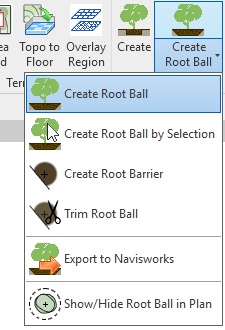
The Proposed Root Balls menu is available from the Artisan ribbon.
Note that there is a separate utility to create Root Balls for Existing Trees.