

The Fencing and Railings tools in CS ArtisanRV enable landscape professionals to quickly create intelligent, terrain-aware boundary and enclosure elements that automatically adapt to the site's underlying geometry. Unlike conventional Revit railings, CS ArtisanRV fencing is specifically designed for landscape applications, ensuring that fence runs accurately reflect real-world construction requirements while remaining fully coordinated within the BIM model.
When a fence is placed, CS ArtisanRV projects the fence alignment onto the underlying Topography, TopoSolid, Floor, or Filled Region, calculating the true projected length of the fence run across the terrain. This real-world length is then used to position posts accurately according to the dimensions and spacing defined by the selected fencing type. The result is a realistic representation of the constructed fence, even across sloping or uneven ground.
Rails automatically follow changes in surface levels, while vertical pales and panels are stepped where required to maintain correct alignment with the supporting terrain. This provides an accurate model representation and helps ensure that quantities, spacing, and installation requirements are reflected correctly throughout the design process.
Fencing is defined by selecting a Base Fencing Family and an associated parametric Fencing Type, allowing a wide range of fence styles and configurations to be created from a consistent set of tools. Fence objects can also be classified using a Location parameter, helping teams organise and structure project data for documentation, specification, and scheduling purposes.
To support detailed design and project delivery workflows, manufacturers' product information can be incorporated directly into CS ArtisanRV fencing families. This enables model elements to carry specification, performance, and procurement information alongside their geometric representation.
Default schedules are automatically updated as fencing is added or modified within the model, providing dynamic quantities and project information directly from the BIM dataset.
The following fencing options are available:
Within this section of the Help system, you will learn how to:
By combining intelligent terrain-following behaviour with automated scheduling and BIM-ready data management, CS ArtisanRV helps landscape professionals produce accurate, coordinated fencing designs that remain aligned with both site conditions and project documentation requirements.
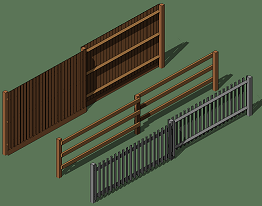
Create - Define Fencing by selecting a Base Fencing Family and parametric Fencing Type
Edit - Modify Fencing placed in the model by selecting a different Base Fencing Family, edit Type properties or change Location parameters.
Flip - Mirror Fenceline in plan view to define innner and outer face.
Create Default Schedules - Load pre-defined planting schedules into the current model.